Manchester City · Analysis & Features
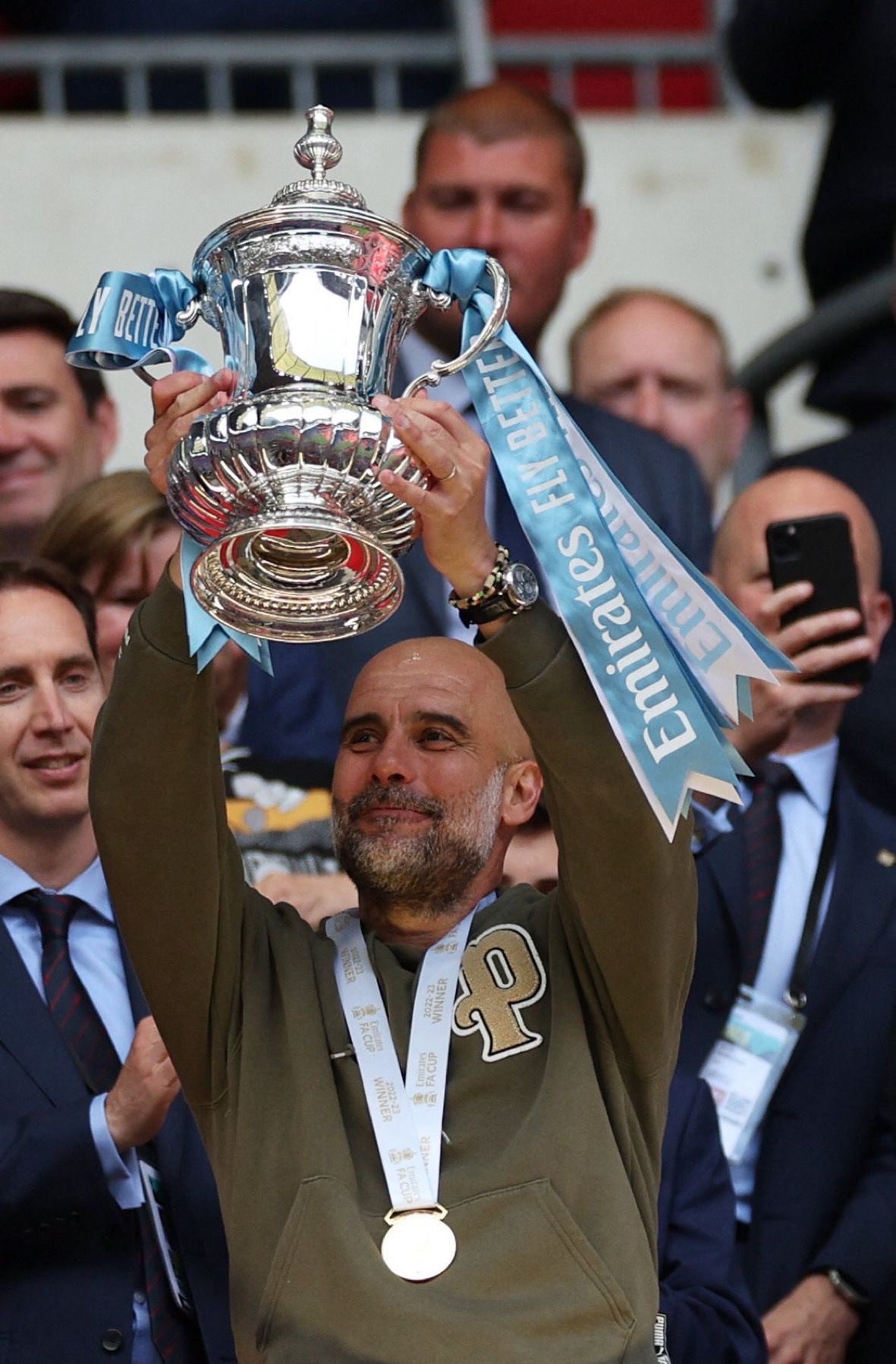
Twenty Trophies. Ten Years. One Man. Pep Guardiola’s Manchester City Reign Is the Greatest Managerial Achievement in English Football History
A decade of dominance. A revolution disguised as a football club. And a manager who didn’t just win — he rewired what winning meant.
Numbers tell stories. But sometimes, the numbers become so large, so overwhelming, so relentlessly stacked upon one another, that they stop feeling like statistics and start feeling like mythology.
Twenty trophies. Ten years. One manager. One city.
Pep Guardiola arrived at Manchester City in the summer of 2016 carrying the weight of expectation that would have crushed most mortals. He had already conquered Spain with Barcelona. He had already dominated Germany with Bayern Munich. But English football? The Premier League? The roughest, most unpredictable, most physically demanding league on the planet? That was different.
Or so everyone thought.
What followed over the next decade was not just a trophy haul. It was a systematic dismantling of every football truth English supporters had ever held sacred. And with the confirmation of his 20th major honour at Manchester City, Guardiola has officially written his name into a tier of football management that very few — perhaps none — will ever reach again.
The Weight of What Twenty Trophies Actually Means
Let’s stop and breathe for a moment. Because it’s very easy to read “20 trophies” and allow the brain to process it like a cricket score — impressive, abstract, slightly unreal.
So let’s break it down.
Six Premier League titles. That’s more than any manager has won with a single club in the modern era. For context, Sir Alex Ferguson won five in his final decade at Manchester United. José Mourinho, the man who built his identity on league domination, has four league titles across his entire career at his peak clubs.
Guardiola has six. At one club. In one city.
Five League Cups. Three FA Cups. Three Community Shields. A UEFA Super Cup. A FIFA Club World Cup. And — the crown jewel that eluded him for seven agonising years at the Etihad — one Champions League, claimed in Istanbul in 2023 as part of an historic treble that stands among the greatest single-season achievements in world football.
When you lay it all out, it doesn’t look like a football manager’s record. It looks like a cheat code.
The Treble Season: When City Became Immortal
The 2022/23 campaign will be studied in football academies for generations. A treble — Premier League, FA Cup, Champions League — achieved with a level of tactical sophistication, squad depth, and mental fortitude that no English club had demonstrated since Manchester United’s own treble in 1999.
But even Ferguson’s treble, magnificent as it was, came with two dramatic late goals at the Nou Camp. Guardiola’s treble was built over ten months of calculated, relentless, beautiful destruction.
It was the moment that silenced every remaining critic. The Champions League had been the ghost haunting Guardiola’s City legacy — the one question mark, the one narrative weapon his detractors used. Istanbul answered all of it, once and for all.
From Chaos to Dynasty: How Guardiola Built the Most Dominant Club in Premier League History
When Guardiola replaced Manuel Pellegrini in 2016, Manchester City were a talented, erratic, occasionally brilliant football club who won things sometimes and disappointed often. They had the money. They had the players. They didn’t have the system.
The first season was difficult. City finished third. Guardiola was questioned. The media wondered whether his style — possession-obsessed, press-intensive, tactically demanding — could survive the Premier League’s physicality and directness.
His response was to go out and win 100 points the following season.
The 2017/18 Premier League campaign remains the benchmark for domestic football excellence. One hundred points. Thirty-two wins. A title secured with five games to spare. It wasn’t just winning. It was winning in a way that made every other club look like they were playing a different sport.
The Numbers Behind the Dominance
| Season | League Finish | Trophies Won |
|---|---|---|
| 2016/17 | 3rd | — |
| 2017/18 | 1st (100 pts) | Premier League |
| 2018/19 | 1st (98 pts) | PL, FA Cup, League Cup, Community Shield |
| 2019/20 | 2nd | League Cup |
| 2020/21 | 1st | Premier League, League Cup |
| 2021/22 | 1st | Premier League, Community Shield |
| 2022/23 | 1st | PL, FA Cup, Champions League, UEFA Super Cup, Club World Cup |
| 2023/24 | 1st | Premier League |
The outlier season — 2016/17 — is actually the most revealing entry in that entire table. It was the only time in a decade that Guardiola walked away empty-handed. And rather than trigger a panic, a rebuild, or a change of identity, it triggered the most dominant twelve months English club football had ever witnessed.
That is the Guardiola difference. Failure, for him, is simply data.
The Tactical Revolution: What Guardiola Actually Changed
Beyond the trophies — and this is critical — Guardiola’s true legacy at Manchester City is architectural. He didn’t just win games. He changed the way the Premier League thought about football.
Before Guardiola, English football’s elite clubs competed in roughly the same tactical language. High tempo. Direct transitions. Physical duels. The occasional moment of technical brilliance within a broadly traditional framework.
Guardiola made that language obsolete.
Positional Play: A New Football Grammar
His concept of juego de posición — positional play — was not simply a passing style. It was a complete reimagining of how space is created, occupied, and exploited. City under Guardiola didn’t just move the ball quickly. They moved opponents. They manufactured chaos for other teams while living in absolute order themselves.
The inverted fullback. The false nine. The half-space domination. The press triggers. These weren’t tactical quirks at City under Guardiola. They were a systematic philosophy, drilled into players until it became instinct.
Players who joined City as good footballers left as different footballers. Kyle Walker became one of the most tactically intelligent fullbacks on the planet. Ilkay Gündogan transformed into a complete midfielder. Bernardo Silva evolved from exciting wide player into one of the most versatile footballing intelligences in world football.
Guardiola didn’t just improve players. He upgraded their entire football software.
The Erling Haaland Question
One of the most fascinating debates in the Guardiola era has been whether the arrival of Erling Haaland in 2022 represented a tactical evolution or a concession. For years, Guardiola had operated without a traditional number nine, using a “false nine” system that confounded defenders and created dynamic overloads across the pitch.
Then Haaland arrived. And then Haaland scored 36 Premier League goals in his first season. The debate became irrelevant almost immediately. What it revealed, instead, was another dimension of Guardiola’s genius — his willingness to adapt his own ideals to maximise the tools at his disposal.
A lesser manager would have forced Haaland into his system. Guardiola evolved his system around Haaland while somehow maintaining the positional principles that had made City dominant in the first place. It was like watching a jazz musician incorporate a new instrument without losing the rhythm of the band.
“The only way to manage at this level for this long is to never stop being curious. The moment you think you know everything is the moment you become easy to beat.”
The Players Who Made the Dynasty: City’s Guardiola-Era Hall of Fame
No manager wins twenty trophies alone. And while Guardiola’s tactical genius is the engine of this era, the quality and character of the players who served under him deserve their own chapter in this story.
- Vincent Kompany — The captain who set the standard before there was a standard to set. His era-defining goal against Leicester in the 2018/19 title run will live forever.
- David Silva — The quiet architect of an era. Ten years of silky, intelligent, effortless control. The Maestro, and rightly so.
- Kevin De Bruyne — Perhaps the finest Premier League midfielder of the modern era. The Belgian engine that powered a dynasty. His injury-interrupted final years cannot diminish what he gave to this project.
- Sergio Agüero — Before Guardiola, and brilliantly alongside him. The greatest foreign scorer in Premier League history, and a man whose statue outside the Etihad will watch over City fans forever.
- Rodri — The 2024 Ballon d’Or winner. The defensive midfielder who became indispensable, who became elite, who became the heartbeat of everything Guardiola built in his latter years at the club.
- Erling Haaland — A force of nature in blue. A Premier League record-breaker and the most complete striker of his generation.
- Bernardo Silva — The player Guardiola has consistently called the most complete in his squad. Technical, tireless, tactically perfect.
These weren’t just good players assembled by Sheikh Mansour’s wealth. They were extraordinary players who became even better inside Guardiola’s system. That distinction matters.
Ferguson, Wenger, Mourinho — Where Does Guardiola Rank Among the Premier League’s Greatest Managers?
This conversation used to be more complicated. It really isn’t anymore.
Sir Alex Ferguson remains the greatest manager in English football history on the grounds of longevity, cultural impact, and the sheer transformation of a club from mid-table contenders to global institution. That story — the twenty-six-year story of a man arriving from Aberdeen and building the most successful English club of the modern age — is incomparable in scope.
But if the question is purely about peak dominance — about the highest sustained level of football played, trophies won, and tactical influence exerted — then Guardiola’s ten-year record at City demands to sit alongside Ferguson’s legacy rather than beneath it.
Arsène Wenger changed the game culturally and gastronomically. José Mourinho delivered trophies through defensive steel and psychological mastery. Jürgen Klopp brought joy and intensity to Anfield and built Liverpool’s greatest European team in thirty years.
But twenty trophies in ten seasons — including a Champions League, six Premier Leagues, and every major domestic honour available — represents a level of consistent, high-quality trophy accumulation that no Premier League manager has ever matched.
The Guardiola vs. All-Time Greats — Trophy Comparison
| Manager | Club | Years | Major Trophies |
|---|---|---|---|
| Sir Alex Ferguson | Manchester United | 26 | 38 |
| Pep Guardiola | Manchester City | 10 | 20 |
| Arsène Wenger | Arsenal | 22 | 10 |
| José Mourinho | Chelsea / Man Utd / Spurs | ~10 | 8 |
| Jürgen Klopp | Liverpool | 9 | 7 |
Ferguson’s 26-year haul remains numerically superior. But Guardiola has achieved two trophies per season on average. Over a decade. That rate of return — sustained, not occasional — is what sets this era apart.
The Difficult Questions: Financial Power, FFP, and Guardiola’s Legacy
No honest assessment of this era can avoid the shadow that has loomed over Manchester City for several years — the Premier League’s financial fair play charges and the question of whether the foundation of this dynasty was built, in part, on impermissible financial advantage.
Manchester City have denied all charges. Legal proceedings have been lengthy and complex. The outcome — whatever it ultimately is — will carry enormous weight for how this era is officially remembered.
But even those most critical of City’s financial conduct cannot argue that Guardiola’s tactical achievements are manufactured by spending alone. Liverpool, Chelsea, and Paris Saint-Germain have all spent enormous sums in the same period without approaching City’s consistency.
Money buys players. It doesn’t guarantee six league titles in eight seasons. It doesn’t produce a treble. It doesn’t turn average squad members into world-class performers through coaching. That part — the part that turns raw materials into a dynasty — belongs entirely to Guardiola.
What Comes Next? The Future of Guardiola’s Legacy
As of the completion of his 20th trophy, Guardiola remains contracted to Manchester City. He has spoken publicly about his love for the club, his relationship with the players, and his continued desire to push boundaries. But the question of when — not if — he eventually departs has grown louder with every passing season.
When that day comes, City will face the most daunting managerial succession challenge in Premier League history. Not since Ferguson retired in 2013 — leaving Manchester United in a managerial wilderness that, honestly, they haven’t fully escaped more than a decade later — will an English club have faced such a profound leadership transition.
Because what Guardiola leaves behind at the Etihad isn’t just trophies and memories. He leaves behind an entire philosophy. An academy reshaped by his principles. A scouting network recalibrated to his demands. A playing style that permeates from the first team to the youth ranks.
Twenty trophies. Ten years. The greatest sustained managerial achievement in English football history. And a Catalan from Santpedor who looked at Manchester City and saw not what they were — but everything they could become.
He was right.
People Also Ask
How many trophies has Pep Guardiola won at Manchester City?
Pep Guardiola has won 20 major trophies during his ten-year tenure at Manchester City, including six Premier League titles, five League Cups, three FA Cups, three Community Shields, one Champions League, one UEFA Super Cup, and one FIFA Club World Cup.
Has Pep Guardiola won the Champions League with Manchester City?
Yes. Guardiola won the UEFA Champions League with Manchester City in the 2022/23 season, defeating Inter Milan 1-0 in the final in Istanbul. It was part of a historic treble — Premier League, FA Cup, and Champions League — one of the greatest single-season achievements in English football history.
How many Premier League titles has Pep Guardiola won?
Pep Guardiola has won six Premier League titles with Manchester City: 2017/18, 2018/19, 2020/21, 2021/22, 2022/23, and 2023/24. His most remarkable campaign was 2017/18, when City accumulated a then-record 100 points. No manager has won more Premier League titles with a single club in the modern era.
Is Pep Guardiola the greatest manager in Premier League history?
Most analysts agree that Sir Alex Ferguson’s 26-year reign at Manchester United remains the gold standard for longevity. However, Guardiola’s rate of trophy acquisition — two per season on average — and the tactical revolution he delivered make a compelling case for the most concentrated period of elite management the Premier League has ever seen.
What is Pep Guardiola’s total trophy haul across all clubs?
Across his entire career including Barcelona and Bayern Munich, Guardiola has won well over 30 major trophies globally — multiple La Liga titles, Bundesliga titles, and Champions Leagues — making him one of the most successful club managers in football history.
How long has Pep Guardiola been at Manchester City?
Pep Guardiola joined Manchester City in the summer of 2016, replacing Manuel Pellegrini. He has now completed ten full seasons at the Etihad Stadium, making him one of the longest-serving managers at a top Premier League club in the modern era.
Will Pep Guardiola leave Manchester City?
As of 2026, Guardiola remains at Manchester City under contract. While speculation about a future international role has circulated, he has consistently reaffirmed his commitment to the club and no formal departure has been confirmed.
Sources
- Premier League Official Statistics — premierleague.com
- UEFA Official Records — uefa.com
- Manchester City FC Official Club History — mancity.com
- The Athletic — Premier League Historical Analysis
- FIFA Club World Cup Official Records — fifa.com
- Sky Sports — Guardiola Trophy Timeline Feature
- Opta Sports — Guardiola Managerial Statistics Database